

✨ Step-by-Step for End Users
1
Log in to Your Account
- Go to AirMDR Admin console.
- Use your credentials to SignIn.
2
Create Alerts on AirMDR
-
Create the API key.
Refer to 🔗 How to generate an AirMDR API Token
-
To create alert on AirMDR services use the following API request
Fill in:
- API URL: Create alerts
-
Method:
POST -
🔐Authentication (AirMDR API Key).
Choose what types of alerts you want sent automatically (e.g., all, critical only, specific policies).
3
Payload Format and Mandatory Params
-
Define the payload format (default is JSON).
📦 Request Body Parameters for creating alerts:
📋 Quick Example: Sending Alert to AirMDR via Webhook
Request sample
Response sample
Investigation Status Values:Created = 0,
Submitted = 5,
InProgress = 10,
Completed = 15,
Failed = 20
Submitted = 5,
InProgress = 10,
Completed = 15,
Failed = 20
AirMDR Alerts Dashboard UI
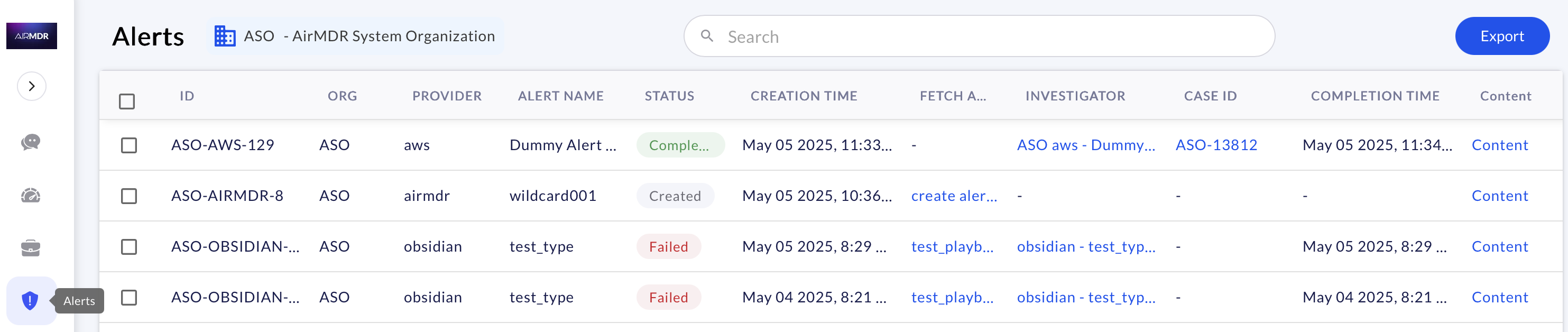
If the User provides the alert_type parameter, AI automatically
- Creates a new Investigator Playbook (If there is no existing playbook for specified alert_type)
or - Investigate the alert within the existing Investigator Playbook and
- Creates a Case (Everytime a new Case is generated in the Case Management).